

ACSF v IELTS

ACSF v IELTS Header

The IELTS is an internationally recognised English ability framework, but how does it line up with the ACSF that is used more commonly within the VET sector?


The International English Language Testing System (IELTS) is an international recognised standard test for English language ability. Many higher education institutes require a minimum IELTS score as a prerequisite/entry condition of some courses, generally Diploma level or higher. With so much emphasis on the Australian Core Skills Framework (ACSF) in the VET sector we are frequently asked how these different scales of classification relate to each other.

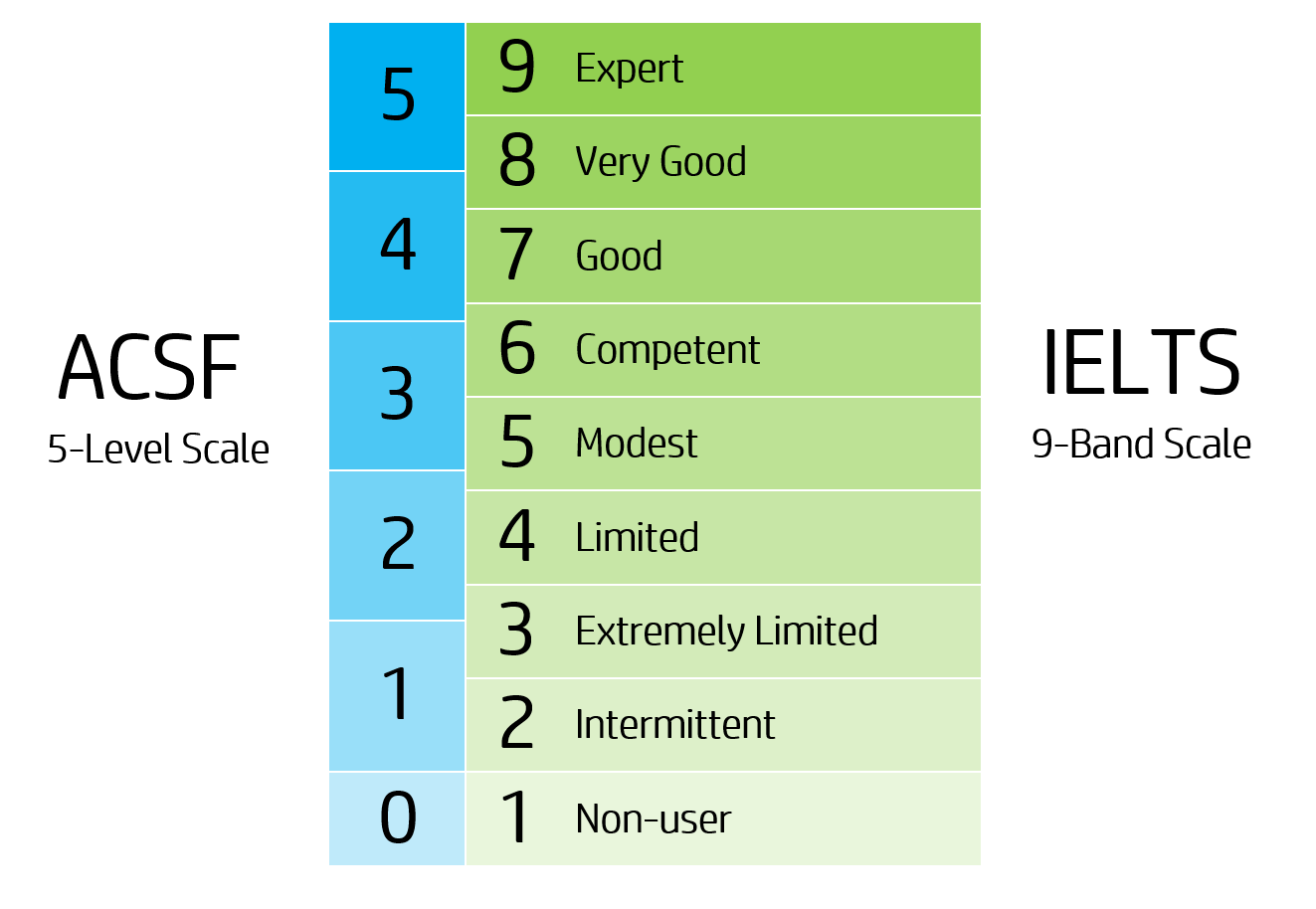
The diagram shown here provides a rough overview of how these 2 frameworks line up.

ACSF v IELTs bands

Using the diagram you can see that an IELTS level 6 requirement is equivalent to ACSF exit level 3. This would indicate that a person should be able to meet all of the language requirements associated with level 3 ACSF and demonstrate some ability towards level 4 skills.

IELTS level 7 however rests clearly within ACSF level 4, but not necessarily exit level 4, allowing for some skills to still be under development. In these instances, you would expect that by the end of training a person should be regularly demonstrating skills at ACSF level 5.


Please note, this is only a guide and the use of an ACSF testing tool does not replace the requirements for IELTS testing, but rather provides additional evidence of a person’s English language proficiency, as well as numeracy and learning skills.

For more information visit https://www.ielts.org/


ABOUT THE AUTHOR


David Cunning

David Cunning

Linkedin Twitter Email

David Cunning is the General Manager of The Learning Resources Group. He has been in the VET sector for 12 years and has spent the best part of the last decade managing the creation of training and assessment resources for over 300 units of competency. He was the driving force behind the LLN Robot System of assessing and supporting vocational education students across the country.

Dave has invested himself in understanding the industry by attaining his Certificate IV in Training and Assessment and also a Diploma of Vocational Education and Training and a Diploma in Training Design and Development.

Prior to working in the VET sector, Dave was a psychology graduate and a graphic artist who ran his own independent publishing house.

Outside of TLRG office, Dave was voted the world's greatest dad by a 2/3 majority of his 3 sons. He is an amateur e-sports participator, avid motorcycle accumulator and aspires to be the single largest consumer of 2-minute noodles in the southern hemisphere. 


Read More

Competency Isn’t Enough: Rethinking Digital Skills in 2026

Competency-based training still matters, but on its own, it’s not enough for digital skills. It does a great job of proving someone can perform a task under known conditions. The problem is that digital environments don’t stay consistent. Tools change, workflows shift, and AI introduces new layers of complexity. Learners can be “competent” in training and still struggle when those conditions change.

The gap isn’t in effort or ability; it’s in underlying understanding. That’s where capability comes in. Capability is what allows someone to adapt, question outputs, and transfer their skills into new or unfamiliar systems. It’s what keeps performance intact when the environment evolves. The takeaway is simple:

Keep competency as the outcome & start building capability as the method.

That shift is what turns short-term success into long-term effectiveness.

There’s nothing inherently wrong with competency-based training. In fact, it’s one of the strongest features of the Australian VET system. It gives us clarity. It defines expectations. It creates a shared understanding of what “good” looks like in the workplace.

But when it comes to digital skills, something isn’t quite lining up anymore.

Not in a dramatic, system-breaking way. More in the quiet, familiar sense that learners can complete the training, tick the boxes, and still feel uncertain when they hit the workplace. Or worse—they feel confident right up until the moment something changes.

And in digital environments, something always changes.