

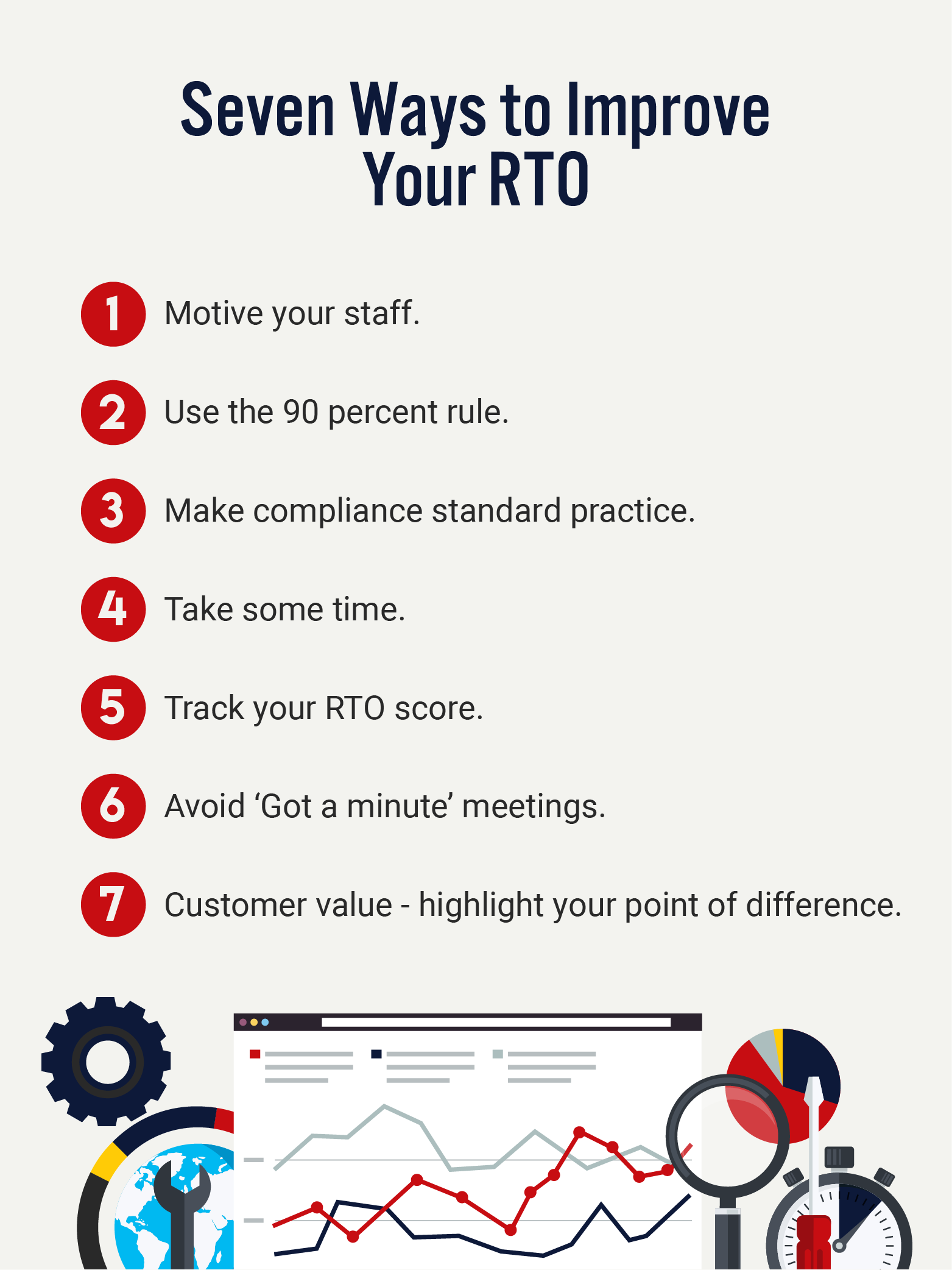

Seven Ways to Improve your RTO - Part 2

Seven Ways to Improve your RTO

This is the final article in a two part series on Seven Ways to Improve your RTO. You can read the first four reasons here: tlrg.com.au/blogs/news/seven-ways-to-improve-your-rto-part-1.

Just a recap they were:

  1. Motivate your Staff
  2. Use the 90 Percent Rule
  3. Make Compliance Standard Practice
  4. Take some Time

Now let's get into the final 3 ways to improve your RTO.


You want to run your business better. You have a long list of things to take your business to the next level but you don’t know where to start. Here are 7 things you can do in your RTO now that can have a significant impact.

5. Track Your RTO Score

Tracking results accurately can be more useful than you realise. Look at the data you already have on hand. Your software can tell you enrolment data, course profitability, and key financial numbers.

Don’t try to look at everything at once. Pick one element to focus on understanding better each month. You will be making informed changes and key improvements in no time.

6. Avoid 'Got a Minute' Meetings

The most effective way to lose productivity from office staff is the ‘Have you got a minute?’ meeting.

Nothing of value can be sorted out in a minute so the ‘a minute’ turns to 15 minutes. Whoever was interrupted has completely lost their workflow and train of thought.

It is much more efficient to send an email saying ‘Can we meet for 10 minutes at 3 pm to discuss ##’. It means the meeting topic is not off the cuff and both attendees can be prepared.

You can take this one step further with the "No agenda, no meeting. No exceptions." rule.

7. Customer Value - Highlight your Point of Difference

Irrespective of what you train, your clients could get training in the same competency elsewhere. How are you different from your competitors?

It isn’t always price or quality of training that makes people choose you. You need to find a way to differentiate yourself. Most importantly, you need to make it easy for your clients to differentiate you. If you have access to post training employment opportunities - tell them. If you have an easier enrolment process that saves time put it on your marketing. If you have invested in the world's best online training software, whatever it is, make sure people know about it.

Seven Ways to Improve your RTO - Tip Sheet


ABOUT THE AUTHOR


Matt Peachey

Matt Peachey

Linkedin Twitter Email

Matt Peachey is the Managing Director at the Learning Resources Group. Over the past decade, he has grown the small resource development company into one of the largest training resource providers in the country and industry leaders in digital and LLN space of Vocational Education Support.

Matt has spent extensive time working directly with RTO’s all over the country to help them implement their training and assessment programs. He has also assisted a number of RTO’s with their marketing and business strategies.

Recently, Matt has orchestrated the transition from Safe Work Resources into The Learning Resources Group to ensure that the organisation is poised to support the VET industry through future changes.

Prior to his work in the VET sector Matt had 10 years working in the automotive industry firstly in sales management and eventually as a process and strategy consultant.

Outside of the TLRG office, Matt can be found volunteering for Lifeline as a counsellor, scouring the countryside for great wine or touring around on his motorcycle.


Read More

Competency Isn’t Enough: Rethinking Digital Skills in 2026

Competency-based training still matters, but on its own, it’s not enough for digital skills. It does a great job of proving someone can perform a task under known conditions. The problem is that digital environments don’t stay consistent. Tools change, workflows shift, and AI introduces new layers of complexity. Learners can be “competent” in training and still struggle when those conditions change.

The gap isn’t in effort or ability; it’s in underlying understanding. That’s where capability comes in. Capability is what allows someone to adapt, question outputs, and transfer their skills into new or unfamiliar systems. It’s what keeps performance intact when the environment evolves. The takeaway is simple:

Keep competency as the outcome & start building capability as the method.

That shift is what turns short-term success into long-term effectiveness.

There’s nothing inherently wrong with competency-based training. In fact, it’s one of the strongest features of the Australian VET system. It gives us clarity. It defines expectations. It creates a shared understanding of what “good” looks like in the workplace.

But when it comes to digital skills, something isn’t quite lining up anymore.

Not in a dramatic, system-breaking way. More in the quiet, familiar sense that learners can complete the training, tick the boxes, and still feel uncertain when they hit the workplace. Or worse—they feel confident right up until the moment something changes.

And in digital environments, something always changes.