

ACSF v AQF: Which levels match what?

ACSF v AQF: Which levels match what?


Since the launch of our LLN Robot System one of the most common questions I am asked is ‘Is ACSF 3 the same as Certificate 3?’

Unfortunately this is a common misunderstanding which is reasonable considering that it would logically be the case, yet it isn’t.

So just to be clear, the Australian Core Skills Framework (ACSF) does not directly match the Australian Qualification Framework (AQF).

  • The Australian Qualification Framework (AQF) has 10 levels from certificate 1 to Doctoral Degree.
  • The Australian Core Skills Framework (ACSF) has 5 core skills, each with 5 levels (1-5) as well as a pre-level 1.


So in answer to the question, Certificate 3 does not equal ACSF core skill level 3.

Core Skills and Qualifications

Core skill levels are not based on qualification levels – two different qualifications at the same certificate level can have very different core skill levels.

For example, some certificate 4 qualifications need a higher understanding of mathematics (ACSF level 4 numeracy) while other certificate 4 qualifications have a much lower focus on numeracy (ACSF level 2 numeracy).

The core skills associated with a qualification are based on the requirements of a job that a qualification relates to or prepares you for. Core skills are not a pre-requisite for training, but are an outcome to be gained or bolstered through training.

How to Compare ACSF and AQF

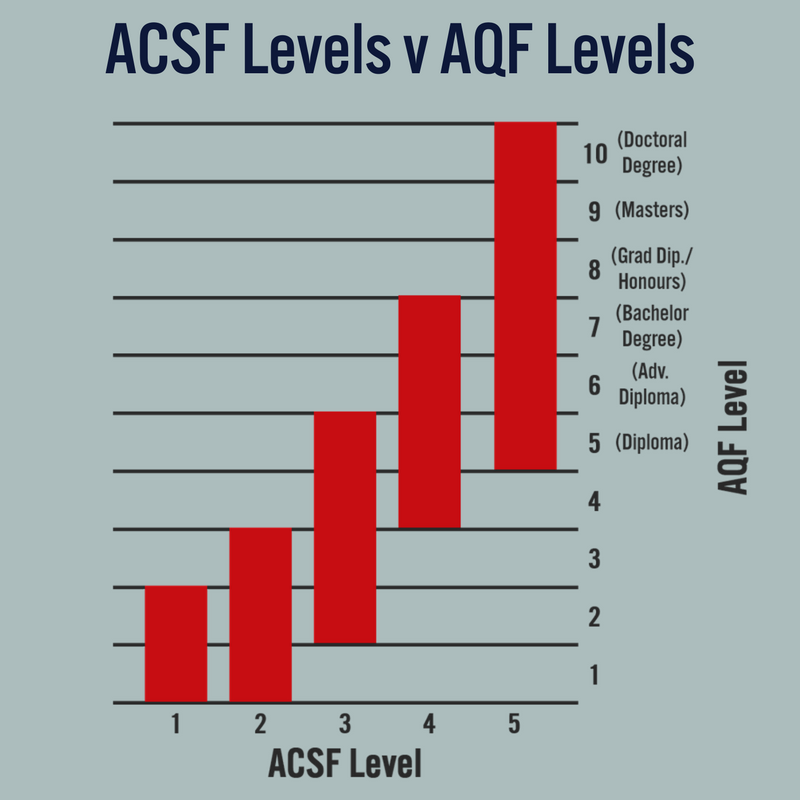
So how do you compare them? This table below gives you an idea of the ranges each of the ACSF levels cover on the AQF scale.

ACSF Levels v AQF Levels

As you can see there is no direct translation but hopefully this helps in giving you an understanding of where they line up.


ABOUT THE AUTHOR


Matt Peachey

Matt Peachey

Linkedin Twitter Email

Matt Peachey is the Chief Executive Officer of The Learning Resources Group. Over the past decade, he has grown the small resource development company into one of the largest training resource providers in the country and industry leaders in digital and LLN space of Vocational Education Support.

Matt has spent extensive time working directly with RTO’s all over the country to help them implement their training and assessment programs. He has also assisted a number of RTO’s with their marketing and business strategies.

Recently, Matt has orchestrated the transition from Safe Work Resources into The Learning Resources Group to ensure that the organisation is poised to support the VET industry through future changes.

Prior to his work in the VET sector Matt had 10 years working in the automotive industry firstly in sales management and eventually as a process and strategy consultant.

Outside of the TLRG office, Matt can be found volunteering for Lifeline as a counsellor, scouring the countryside for great wine or touring around on his motorcycle.


Read More

Competency Isn’t Enough: Rethinking Digital Skills in 2026

Competency-based training still matters, but on its own, it’s not enough for digital skills. It does a great job of proving someone can perform a task under known conditions. The problem is that digital environments don’t stay consistent. Tools change, workflows shift, and AI introduces new layers of complexity. Learners can be “competent” in training and still struggle when those conditions change.

The gap isn’t in effort or ability; it’s in underlying understanding. That’s where capability comes in. Capability is what allows someone to adapt, question outputs, and transfer their skills into new or unfamiliar systems. It’s what keeps performance intact when the environment evolves. The takeaway is simple:

Keep competency as the outcome & start building capability as the method.

That shift is what turns short-term success into long-term effectiveness.

There’s nothing inherently wrong with competency-based training. In fact, it’s one of the strongest features of the Australian VET system. It gives us clarity. It defines expectations. It creates a shared understanding of what “good” looks like in the workplace.

But when it comes to digital skills, something isn’t quite lining up anymore.

Not in a dramatic, system-breaking way. More in the quiet, familiar sense that learners can complete the training, tick the boxes, and still feel uncertain when they hit the workplace. Or worse—they feel confident right up until the moment something changes.

And in digital environments, something always changes.